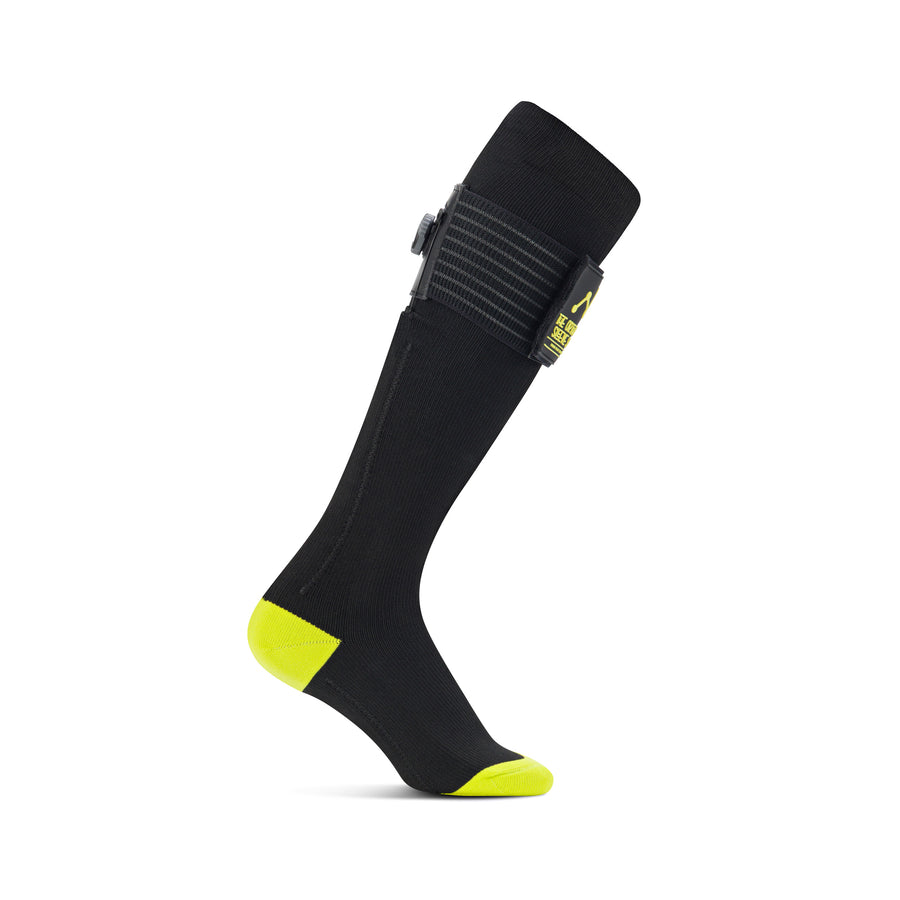
Gastrocnemius · The Orthopaedic Sleeve

Calf Strain Doesn’t Heal Faster With Rest. It Heals With Less Load.

Australia’s Only Evidenced Brace for Calf, Achilles & Heel Pain

Calf tears happen right where the muscle fibres meet the Achilles tendon — the highest-stress point in the calf. Every step re-loads that exact spot. The Orthopaedic Sleeve reduces calf activation by up to 21.9% at push-off and peak Achilles force by up to 8.1%.

↓32%
Gastrocnemius EMG, standing
up to ↓8.1%
Achilles tendon force
up to ↓21.9%
Gastrocnemius at push-off
The Orthopaedic Sleeve for Calf Strain
The University of Queensland — Validated
🔬 UQ Biomechanics Lab Validated
✅ ARTG Registered Medical Device
📋 Ethics Approval #2024/HE001495
🇦🇺 Clinician Designed in Australia

The Injury Is at the Junction. So Is the Solution.

Calf strains most commonly tear where the muscle fibres turn into the Achilles tendon — the inner head of the calf, about mid-leg. Think of a rope fraying where it’s tied to a steel cable. That junction takes the most stress at push-off.

The outer calf crosses both the knee and the ankle, so every step where your knee straightens with your foot on the ground pulls through the injured junction. Every. Single. Step.

Read the full Calf Strain guide →
  • Less work for the injured muscle↓32% gastrocnemius activation in quiet standing
  • Less load at push-offup to ↓21.9% gastrocnemius at push-off
  • Less force through the tendon junctionup to ↓8.1% Achilles tendon force
  • Less time on the heelup to ↓5.1% heel contact time

Figures: independently tested at the University of Queensland School of Biomedical Sciences. Results vary between people; best responders shown where marked “up to”.

The Orthopaedic Sleeve

The Orthopaedic Sleeve

$129 AUD
Choose your size — size guide

Free shipping within Australia · Secure checkout · Dispatched within 2 business days · Our guarantee · Full product details

Verified Customer Reviews

From people with Calf Strain

5.0 from 5 reviews for Calf Strain · 14 across all conditions

Every review below is from a verified customer. We publish them as written — including the parts about what was difficult.

★ Featured Review
★★★★★ ★★★★★

Long Term Calf Injury

I tore my calf muscle pretty badly 5 years ago and it's never healed properly. These days I've just learned to live with the pain when I go for my walks. The last 3 days I've done my 3km walk with the sleeve and I didn't remember what it felt like to not have that pain. This is the first time I've had hope that in future I can walk normally again. It was a little tricky to get on before I learnt the secret of folding it back on itself prior, but now I look forward to using it. Well thought out and fantastic product, I'm considering buying a second for foot pain in the other foot.

★★★★★ ★★★★★

Post-pregnancy recovery support

As a busy mum of three, my body really struggled to feel strong again after my third baby. Between the pram walks, chasing a 2 and 4yr old, and constantly carrying an almost 1yr old, the "daily kid activity" was a massive toll. I was dealing with constant soreness from my calves down to the balls of my feet, and I knew I needed extra support to help my body properly recover.

I found the Orthopaedic Sleeve Society through social media and decided to give them a go. A quick tip: check sizing carefully. I originally ordered a small, which was a bit too tough to get on. Thankfully, their customer service was amazing - they helped me with my sizing queries immediately and swapped it for a medium within the week.

The website is very user friendly, and the instructions super helpful. If you're a parent on your feet all day looking for post-pregnancy recovery support, I'd definitely recommend!

★★★★★ ★★★★★

Calf rehab

I strained my calf while training for a half marathon and was struggling to stay mobile without aggravating it further. The Orthopaedic Sleeve gave me the support I needed to stay active and manage the load until I could safely return to training. Genuinely impressed, highly recommend for soft tissue recovery.

★★★★★ ★★★★★

Calf Tear

I am a woman past her 70's and was given this brace by my physio after I tore my calf. I've been wearing it most of every day and find it a great support. The calf muscle is much more comfortable and improving.

The leg is still a little swollen, so the compression style of the brace (particularly where the seam is stitched) can be uncomfortable at times and on a particular day I was flared up and it left a bit of pain and swelling down at my ankle, so I had to take it off. It has since settled, and I have resumed using it under the direction of my physio.

My biggest problem is putting it on and taking it off. But that is because I have arthritic fingers and find it hard to grip the sock and pull. It's not too small. The whole process is a part of my daily exercise!!!

★★★★★ ★★★★★

Supported Workouts

I've been testing the Orthopaedic Sleeve while recovering from a calf tear, and it's been great.

The fit and compression are really supportive without being uncomfortable. I wore it under my leggings—although it can be a little fiddly to get on and off with the Velcro and dial adjuster, once it's on it sits really well. I could even put socks over the top and it looked completely discreet.

I found it excellent for exercising—during gym classes I could dial up the support and focus on my workout without worrying about re-injury. The sleeve gives so much heel and calf support that I wasn't constantly thinking about my calf tear, which was a relief.

What I love most is how adjustable it is. I could keep it firm and supportive during exercise, then loosen it off for something lighter like walking. That flexibility makes it super practical for everyday recovery and activity.

Overall, this sleeve has helped me get back to moving and working out with confidence. I'd definitely recommend it to anyone recovering from a lower-leg or heel issue.

Seven Conditions.
Four Biomechanical Mechanisms.
One Device.

The Orthopaedic Sleeve

Each condition is addressed by multiple compounding mechanisms — not a single stat. Select your condition to see the full clinical case.

Plantar Fascia 1
Plantar Fasciitis

Stabbing heel pain worst on your first morning step. Four mechanisms compound to reduce fascial load.

↓5.1%
Heel contact time
up to ↓8.1%
Achilles force
↓2°
Ankle angle
↓32%
Calf activation, standing
See Full Case
Achilles 2
Achilles Tendinopathy

Chronic stiffness and pain that worsens with every loading event. Reduces cumulative tensile burden.

up to ↓8.1%
Tendon force
↓32%
Calf activation, standing
↓5.1%
Heel contact
↓2°
Ankle angle
See Full Case
Paediatric 3
Sever's Disease

Heel pain in active kids during growth spurts. The Achilles pulls hard on a soft growing heel bone.

up to ↓8.1%
Achilles force
↓32%
Calf pull, standing
↓5.1%
Heel contact
$129
Accessible price
Learn How It Helps
MTSS 4
Shin Splints

Burning ache down the inside of your shin. Cumulative calf pull irritates the bone's outer layer.

↓20.4%
Soleus EMG
↓21.9%
Gastrocnemius
up to ↓8.1%
Achilles force
↓5.1%
Heel contact
See Full Case
Impingement 5
Anterior Ankle Impingement

Pain at the front of the ankle on dorsiflexion — pinching at end-range during stairs and squatting.

↓2°
Ankle angle
↓5.1%
Heel contact
↓32%
Calf activation, standing
up to ↓8.1%
Achilles force
See Full Case
Gastrocnemius 6
Calf Strain

Gastrocnemius tears and chronic calf overload. EMG-confirmed offloading at the injured muscle.

↓32%
Medial gastroc EMG, standing
↓21.9%
Toe push-off
up to ↓8.1%
Achilles force
↓5.1%
Heel contact
See Full Case
Soleus 7
Soleus Tear

Deep posterior calf pain from soleus disruption — slow to heal under continuous load.

↓20.4%
Soleus at push-off
up to ↓8.1%
Achilles force
↓5.1%
Heel contact
↓32%
Gastroc EMG, standing
See Full Case
The Orthopaedic Sleeve
Interactive 3D Model

Spin It. Zoom In.
Explode It Apart.

Walk around the brace in three dimensions. Switch between the assembled view and the exploded view to see exactly how each component contributes to the four independently measured biomechanical mechanisms.

Rotate & Zoom Exploded View Mobile AR
Open 3D View →
Loads instantly in any modern browser · No app required

Not Compression.
Biomechanical Change.

The only brace with published data on how it helps get you better.

The Orthopaedic Sleeve was independently tested at the University of Queensland School of Biomedical Sciences, using 3D motion capture, force plates, surface electromyography and Hill-type muscle modelling on VALD research-grade instrumentation. What was measured, in which phase of gait, and why each one matters follows.

up to ↓20.4%
Soleus activation
toe push-off, trail leg · 6.9% group mean
The soleus does the bulk of the work in walking and slow running, and it is pulling hardest at the moment the heel leaves the ground. Less activation there is less force delivered into the Achilles at its peak.
up to ↓21.9%
Medial gastrocnemius activation
toe push-off, trail leg · 9.9% group mean
The superficial calf takes over as speed rises. Reducing its demand at push-off is what lowers the load travelling down the chain on faster walking and running.
up to ↓8.1%
Peak Achilles tendon force
walking · best responder
The load the tendon itself carries on each step. A modelled output rather than a direct measurement, and the figure quoted is the best responder in the group.
↓5.1%
Heel contact time
walking · p = 0.009
Each step spends slightly less of its cycle in the phase where the heel is loaded, which spreads the same distance across a gentler set of contacts.
↓10% ROM
End-range control at terminal stance
walking · 2° of available range
Roughly a tenth of the range the ankle uses at the end of stance. The joint is most sensitive at its extreme, so a small shift away from end-range takes the pinch out without restricting normal movement.
↓32%
Medial gastrocnemius activation
quiet standing balance · p = 0.002
This is a standing result, not a walking one. It matters for the person whose day is spent on their feet without going anywhere — retail, theatre, assembly line, teaching — where the calf holds a low, constant postural load for hours.
UQ Final Report — The Immediate Influence of The OrthoSleeve Device on Lower-Limb Neuromuscular Function

About the study

The Orthopaedic Sleeve was independently tested at the University of Queensland School of Biomedical Sciences, under Human Research Ethics approval #2024/HE001495, with the final report delivered in June 2025. Measurement used 3D motion capture, instrumented force plates, surface EMG and Hill-type musculoskeletal modelling, on VALD research-grade instrumentation. In-shoe plantar pressure mapping was measured separately with Paromed sensors.

It is a commissioned validation study, not a peer-reviewed publication and not a clinical trial — we paid for it, it was carried out by researchers in our field under formal ethics approval, and the full report is published on this site for anyone to read and check. The participants were healthy adults, so every figure describes the immediate mechanical effect of wearing the device rather than a treatment outcome in a patient.

Individual maxima are quoted with the group mean beside them because the response varied considerably between participants — which is the ordinary finding for mechanical interventions at the ankle, and the reason a responder trial rather than a group mean is the right way to judge one. No sham-controlled trial of this device in any condition exists yet.

In-Shoe Pressure Mapping

Powered by Paromed · clinical pressure measurement
In-shoe plantar pressure mapping — baseline vs Orthopaedic Sleeve

Visible reduction in heel-impact and forefoot peak-pressure zones (circled) when wearing The Orthopaedic Sleeve, measured with Paromed in-shoe sensors. Independent measurement, separate from the UQ study.

A/Prof Taylor Dick & Dr James Williamson — UQ School of Biomedical Science Independent study · Ethics Approval #2024/HE001495 · Conducted in partnership with VALD · UQ Final Report June 2025
The Orthopaedic Sleeve Achilles Tendinopathy Plantar Fasciitis Calf & Shin Conditions Anterior Ankle

The Orthopaedic Sleeve.
Built Around
the Evidence.

Every material and design decision in The Orthopaedic Sleeve was made to deliver the four biomechanical outcomes measured in the UQ study. ARTG registered. Clinician designed. $129 AUD.

✓
Offloads the Entire Posterior ChainMeasurable reduction in soleus, medial gastrocnemius, Achilles tendon force, and knee joint load — simultaneously, in a single device.
✓
Modifies Heel Contact Mechanicsup to 5.1% reduction in heel contact time means less time on the heel with every stride — less time loading the fascial origin and, in growing heels, the apophysis.
✓
Reduces Anterior Ankle End-Range Compressionup to 2° reduction in anterior ankle angle delivers 10% less of the range used at end of stance for impingement presentations.
✓
Active on Every StepEvery single step reduces load — not just at rest. The mechanism is biomechanical, working through your gait, not pressure alone. 90.9% of study participants felt safe.
Order Now — $129 AUD

Prescribe with
Confidence.

Designed by a Principal Physiotherapist. Every mechanism is documented, every claim is referenced, and every indicated condition has a clear biomechanical rationale your patient can understand.

✓
ARTG Registered Medical DeviceFull compliance documentation available for prescribers and clinic records.
✓
Independently TestedValidation study, University of Queensland School of Biomedical Sciences. Ethics #2024/HE001495. Full report published on this site.
✓
Condition-Specific Rationale DocumentedBiomechanical mechanism sheets for all seven indicated conditions — ready for patient education.
✓
Bulk Ordering AvailableClinic accounts with preferred pricing for high-volume prescribers.

Access Resources & Bulk Pricing

Prescription guides, condition-specific clinical rationale, and a direct account manager for clinic orders.

Clinician Resources

Explore Another Condition

The Orthopaedic Sleeve
Australia’s Only Evidenced Brace for Calf, Achilles & Heel Pain
Stop Managing Pain.
Get Back to Performance.

Seven conditions. Four measurable mechanisms. One University of Queensland and VALD-validated device. For athletes, workers, and everyone in between.

$
129
AUD

Order The Orthopaedic Sleeve →

Free shipping within Australia  ·  Secure checkout  ·  Dispatched within 2 business days

ARTG Registered
Independently tested at UQ
Condition Wear Guide Included
Australian Support